
Blog
Plan the BEST Year Yet with Our Curriculum Map for Teachers!
Designing an Effective Curriculum Map for Teachers
My first official day of summer typically begins with a cup of coffee, a watering can, and a blank stickie note. After I give myself and my plants a sweet drink, I sit down to plan my summer bucket list. Like most teachers, I use this time to catch up on all the “honey-do” items I missed throughout the year and also look ahead to what’s next. I have yet to have a year where I don’t have a change to my schedule. Whether I’m teaching a new course, coaching a new sport, or like this year, adopting a new textbook, I use the summer months to plan and prepare. For me, I’ll start this preparation with a map.
A curriculum map is a planning tool that gives teachers a clear visual outline of what will be taught, when it will be taught, and how learning will be assessed. It helps bring together content, skills, standards, and assessments so instruction stays coherent and purposeful from start to finish. Whether you are using this map to propose a new course to your school board or to update a curriculum, if designed well it can provide structure, direction, clarity, and stronger learning outcomes across a course. Here’s how I think of an effective curriculum map: Could a new teacher use this map to write daily lesson plans and this course? If so, you’ve created an effective map. If you’re like me and need some direction on a new, looming curriculum beginning next semester, let’s map it out!
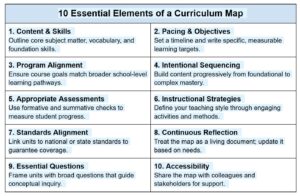
1. Begin at the end: Identify Essential Content and Skills
What, ultimately, do you want the students to know and be able to do by the end of the course? Every strong curriculum map begins by outlining the core subject matter, key concepts, essential vocabulary, and the skills students must develop. These elements define the “what” of the course and establish the foundation for meaningful instruction. By identifying the core concepts and skills ear
ly, teachers can focus on the most important learning priorities and avoid overcrowding the course with unnecessary details.
Once you have an idea of the greater unit, start chunking the idea into manageable lessons. In our curriculum map template, you’ll see how ‘the whole is made up of the sum of its parts.
2. Pace yourself and define clear, measurable learning objectives
Do you have a week? A month? A semester? A year? How much time do you have for each unit? A pacing calendar is a helpful tool for allocating time for addressing each learning objective. Click to download our Teacher’s Academy Pacing calendar to help!
When writing Learning Objectives, ensure they are specific, measurable, and aligned with standards and real-world applications. I typically follow this formula for writing a Learning Objective:
Students will be able to…
[observable, measurable action verb] + [materials available] = [specific, measurable outcome]
Example: Students will be able to…
Summarize the main rights provided to the French society using the excerpt from The Declaration of the Rights of Man and Citizen with 90% accuracy.
Strong objectives give direction to both teaching and assessment while making expectations transparent for students. It’s not uncommon for me to post the daily objectives as the first and final parts of each lesson.
3. Align Course Objectives With Program or School-Level Outcomes
Curriculum mapping should show how course-level outcomes contribute to broader program goals, ensuring strong alignment across grades, departments, or subject areas. This connection creates coherence throughout the curriculum and helps teachers spot gaps, overlaps, or redundancies before instruction begins. When outcomes are aligned, the course becomes part of a larger, intentional learning pathway.
4. Sequence Units and Learning Experiences Intentionally
Careful sequencing ensures that content builds progressively so students can move from foundational knowledge to more complex understanding. A well-sequenced curriculum map helps teachers visualize timing, unit order, and the relationships between concepts across the course. This kind of scaffolding supports long-term retention, deeper comprehension, and stronger mastery over time. When it comes to sequencing, I think of Bloom’s Taxonomy and how we might expect our students to work their way up the pyramid of skills from basic knowledge to thoughtful evaluation. For more on Bloom and additional skill-based verbs to sequence your teaching, check out Cornell University’s Center for Teaching Innovation.
5. Select Appropriate Assessments
Assessment should align with learning outcomes and content so teachers can measure what students are expected to learn. In other words, at the end of each lesson (and often times, during), are you checking in to see if what you’re teaching is landing? Including both formative assessments, which provide ongoing feedback, and summative assessments, which evaluate final achievement, helps ensure students are progressing toward stated goals throughout the course. See our teacher’s top picks for formative and summative assessments.
6. Identify Learning Activities and Instructional Strategies
Beyond content and assessment, teachers should include key activities, methods, and instructional materials in the curriculum map. Basically, the fun stuff. Here is the step that defines your style, approach and effectiveness. Are you the pragmatic lecturer? The hands on explorer? The facilitator? Or a combination? Your instructional strategies determine how students will engage with the material and reflects both individual lessons and the bigger instructional vision. The Teacher’s Academy provides online professional development to help develop instructional strategies through resource exploration and engaging experiences. New teachers, it can take several years to develop your “show” and realize which instructional strategies work best for your personal style and audience. Be patient and try everything! Veterans- you’re never too old to learn new tricks. Surprise yourself and try on a new strategy this year! Remember, instructional strategies evolve and the best teachers can read the room and know what hat to wear in the moment.
7. Note Standards Alignment
Whether using national, state, or district standards, standards alignment ensures consistency and guarantees coverage of expected learning outcomes. Consensus maps often include non-negotiable standards and expectations so that teachers stay focused on shared priorities while still planning effectively for their own students.
8. Make Room for Reflection and Continuous Improvement
Curriculum maps are living documents that should be revisited regularly to revise content, update activities, and adjust assessments based on student needs and faculty collaboration. Treating the map as an evolving resource helps ensure it stays relevant, effective, and responsive over time. Pro tip: It’s worth it to make the changes right away. If a lesson didn’t go exactly as planned and you have “I’ll fix that later” thoughts, do it now! Your future self will thank you for it! Always make the updates as soon as you think of them!
9. Incorporate Essential Questions
Many curriculum design frameworks suggest adding broad, overarching essential questions to guide student inquiry and provide conceptual focus. These questions help frame the purpose and direction of the course. I teach 10th grade World History and for my course, the questions are thematic. For example, “How does technology devalue human life?” or “How does an economic system guide social norms?” Essential questions can be used to introduce the course and referenced throughout the duration of the entire course.
10. Make the Map Accessible and Shareable
I can’t imagine a world where I would embark on this task alone- but that’s me! My advice would be to find a colleague to map your course together. Then share it with the stake holders. Curriculum maps should communicate expectations clearly to colleagues, administrators, and, when appropriate, students. Having a shared structure supports transparency and coherence across teaching teams.
Get Started…
A complete curriculum map for a new course brings all of these elements together into one clear, practical planning document. When the map connects content, skills, assessments, and standards, it creates a more coherent learning experience for both teachers and students. But like all new beginnings, that first step is always the hardest. The Teacher’s Academy has provided an editable curriculum map template (and pacing guide!) to get you going.