
Blog
First Day Lessons for Every Teacher
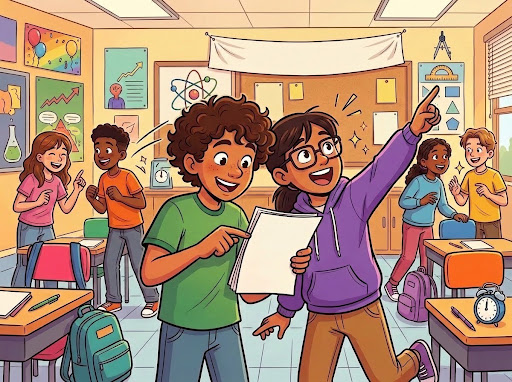
I remember sitting in an August in-service listening to our superintendent address the staff. His back to school message was all about that dreaded first-day of school lesson. He proposed that this lesson should be the best lesson of the year. Collectively, the teachers immediately balked at that notion with a laughing grumble. It was agreed, first day lessons are boring. Yet, the incredulity of his message made me think twice. What if I did make my first day lesson one to remember? Challenge accepted. It turns out, it IS possible to have an engaging and memorable first day.
Below are 10 tried and true lessons that your students will remember, and you will no longer dread that first day awkward silence.
1. The “Would You Rather” Icebreaker Debate
Post a series of would-you-rather questions (silly ones first, then ones tied to your subject For example, “Would you rather solve for x or graph it?” Students move to different corners of the room based on their answer, then defend their choice to a partner. It gets kids talking and moving in the first ten minutes, and you can quietly observe who leads, who hangs back, and who needs a nudge.
Best for: Breaking the ice fast, any grade level, any subject.
2. Name Tents with a Twist
Instead of a plain name tag, check out the twist @thesassyteacher did with her name tents. From pre-assessments to personal trivia to teacher facts, there’s a world of opportunity with this name tent idea!
Try this: After class, collect the name tents and jot a note on the inside of each one — a question, an encouraging word, a connection. Return them the next day with your notes waiting inside.
I don’t do name tents with my seniors, so instead, I have them meet someone new and make up a secret handshake. While they are working on their handshakes and/or sharing them with the class, I walk around and introduce myself and simply ask them ways I can remember them… You’d be surprised what middle school and high school students will say on the first day- quite memorable! Side note, finding your handshake partner is an easy and fun way for the students to find a quick mate for partner work.
Best for: Building individual rapport quickly; works especially well for teachers with 100+ students who need a memory aid.
3. The Syllabus Scavenger Hunt
Turn the dreaded syllabus read-aloud into a scavenger hunt. Give students 10 questions such as, “What’s the late work policy? Find the teacher’s office hours.” and let them search the document in pairs, racing to finish first. They walk away actually knowing the policies instead of having zoned out during a monologue.
Make it kinesthetic and post sections of your syllabus around the room. (Have the bathroom procedures by the sign-out sheet, etc!)
Best for: Middle and high school; any subject with a detailed syllabus.
4. Classroom Constitution
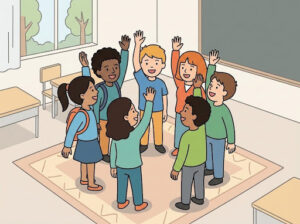
As a whole class, brainstorm and vote on the norms that will govern the room — respect, participation, phone use, whatever matters most. Frame it as writing a shared “constitution” rather than receiving a list of rules. Students are far more likely to follow guidelines they helped write, and it’s a natural entry point into discussing agreements, governance, or persuasive writing depending on your subject.
To get genuine buy-in, try assigning this task to small groups. Give them scenarios and task them with devising a set of rules and expectations for their “mini-class.” During the whole-group share-out, any “matching rules” can be adopted for the class.
Best for: Building buy-in and ownership; adaptable for elementary through high school.
5. Diagnostic Disguised as a Game
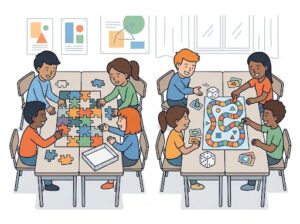
Instead of a flat pre-assessment, turn it into a low-stakes game — a Kahoot, an “escape the room” puzzle, or a set of stations with problems of increasing difficulty. You get the diagnostic data you need for planning, and students get to start the year with something that feels like play rather than a test.
Best for: Any subject where you need a baseline read on skill levels.
6. The Interview Web
Pair students up to interview each other, then have each student introduce their partner to the class instead of themselves. As introductions happen, build a visible “web” on the board connecting students who share something in common (same pet, same favorite subject, same hometown). By the end, the class can see how connected they already are.
Best for: Younger grades and any class where students don’t already know each other.
7. Mystery Box / Object Lesson
Bring in an object connected to your subject — a fossil for science, an old photograph for history, a strange equation for math — and let students speculate about it in small groups before you reveal what it is and why it matters. It’s a low-pressure way to preview the year’s big questions and get students curious before you’ve assigned a single worksheet.
Best for: Hooking interest and previewing course themes.
8. Goal-Setting Time Capsule
Have students write a letter to their future self: goals for the year, a prediction about how they’ll grow, maybe a worry they want to look back on later. Seal the letters and hand them back at the year’s midpoint or on the last day of school. It’s a simple ritual that builds reflection habits and gives students (and you) a powerful before-and-after.
Best for: Any age; especially meaningful in advisory periods or homeroom.
9. Collaborative Class Playlist or Mural
Ask each student to contribute one object that represents them such as a song, a quote, or a hand-drawn tile for a class mural. Assemble it together (a shared class playlist, a bulletin board mural, a digital slide deck) so the finished product becomes a visible symbol of the whole class, made by everyone.
Best for: Creating a lasting classroom identity; great for art, music, and homeroom classes.
10. Real Content, Low Stakes
Sometimes the best first-day lesson is simply a genuinely interesting slice of real content with no grades attached. This could include a thought-provoking discussion question, a short problem that has multiple valid approaches, a “what do you notice/wonder” image. It signals to students that this class is going to be intellectually engaging, not just a semester of rules and logistics.
Best for: Older students who can smell a “wasted” first day a mile away and appreciate being treated like they’re there to learn something.
The Bigger Picture
Notice that none of these are “hand out the syllabus and read it line by line.” The first day is precious — it’s the only day all year when every student walks in with a completely open mind about what your class will be like. Use it to show them, rather than tell them, what kind of classroom you’re building.
Pick one or two of these that fit your subject and personality, adapt them, and don’t be afraid to let your first day feel a little different from day two. That contrast is exactly what makes it memorable.