
Blog
How are teachers using AI?
What exactly is AI, and who needs to learn it now?
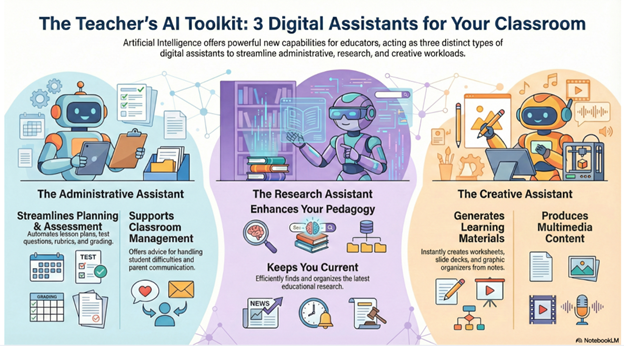
Artificial intelligence is no longer a future concept—it’s in our schools, our tools, and our students’ lives. Right now, AI should be dominating teacher in-services to alert them of how it is being used by students (in potentially dangerous ways) but also to see how many of us are using AI to get ahead. AI can help us gain back time, direction, and instructional focus. Let me share with you just a few ways that teachers are incorporating AI to boost productivity and professional growth.
- Time-Saving Assistant: AI is used to create first drafts and help with tasks like lesson planning, assessments, rubrics, parent communication, and classroom management scenarios.
- Research Assistant: It helps teachers efficiently locate, summarize, and organize educational research to stay informed on best practices, pedagogy, and policy.
- Creative Assistant: AI can generate resources such as visuals, presentations, videos, audio resources, and worksheets, helping teachers refocus their creativity on designing engaging learning experiences.
- Rigor Partner: Teachers can use AI to elevate questioning, strengthen writing expectations, and design authentic tasks that push learning beyond simple recall into analysis and real-world application.
Of course, the challenge for teachers isn’t curiosity; it’s time. The Teacher’s Academy prepared a 15 hour professional development course called, AI Tools for Teachers, designed specifically for busy those of us who want practical, classroom-ready ways to understand and use AI without being overwhelmed by tech jargon or hype. This course helps demystify AI by showing how it works, programs to try, why it matters, and how it can immediately support teaching and learning.
How are teachers using AI to increase rigor in lesson plans?
Rigor is about deeper thinking, not more work—and AI supports teachers in designing rigorous lessons thoughtfully. Take a look at how teachers are using AI to enhance intellectual demands of their lessons:
Elevating Questioning from Recall to Evaluation:
Instead of asking students to recall the steps of the scientific method, a teacher can provide AI with their existing comprehension questions and prompt it to generate a new set of questions that require synthesis and evaluation. For instance, asking students to evaluate which step of the scientific method was most crucial in a specific historical discovery, and justify their reasoning.
Strengthening Writing Expectations with Complex Prompts
A teacher can input a basic essay prompt and ask AI to transform it into one that demands evidence-based reasoning and nuanced argumentation. The AI could help the teacher design a prompt that requires students to incorporate and critique multiple viewpoints, or apply a theoretical concept to a modern-day scenario, pushing their writing beyond a simple summary.
Designing Authentic Tasks for Real-World Application
For a civics lesson, a teacher can ask AI to take the core content and create a detailed, real-world simulation scenario. For example, the AI could help generate a scenario where students must act as policymakers, analyze mock data on a community issue, and then write a persuasive proposal to a local government board, forcing them to apply their knowledge to solve a complex, authentic problem.
In our course, AI Tools for Teachers, teachers will take a lesson that could use this kind of update and ask AI to work its magic. What an ideal way to spend your professional development time!
Should our students be using AI?
At this time, The Teacher’s Academy is promoting only teacher use in the classroom. Although we acknowledge students have access to generative AI (answers, images, ideas) right at their fingertips, we also acknowledge that teachers control the time in the classroom. The latest data shows concerns for what’s been coined as “cognitive offloading” and overuse by students. According to research by Dr. Jared Horvath, AI and other elements of technology are stunting student learning.
Concerns with using AI in the classroom primarily fall into one of three categories:
- Academic Integrity: The potential for students to use AI to complete assignments without engaging in the necessary critical thinking or learning process.
- Ethical Use: Ensuring students understand the responsible and ethical use of technology, including data privacy and avoiding bias in AI-generated content.
- Skill Development: Over-reliance on AI may hinder the development of essential skills like independent research, original writing, and problem-solving. Educators must guide students to use AI thoughtfully to deepen, not replace, their learning.
It’s here. That’s true. Teachers should learn AI, use AI, be able to recognize AI in student work and adapt to students having access to AI, but as far as teaching goes, the old school teaching methods are way more effective for learning!