
Blog
Rethinking Authentic Assessment in an AI-Powered World
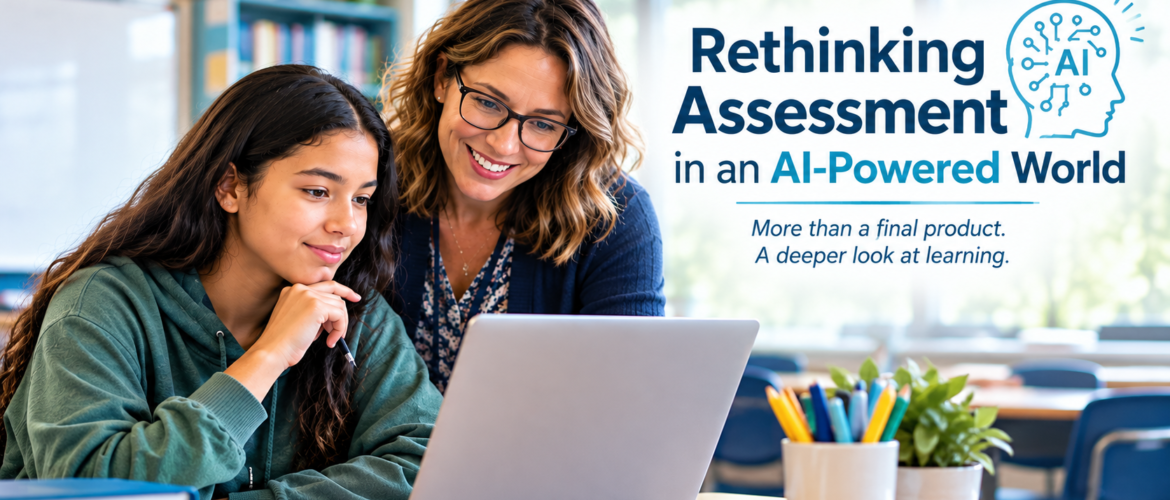
Rethinking Assessment in an AI-Powered World: Are We Measuring Learning or Just the Final Product?
Artificial intelligence is changing the way students research, write, solve problems, and demonstrate their knowledge. With AI tools increasingly capable of generating essays, answering questions, explaining complex concepts, and creating polished presentations, educators face an important question: How do we authentically assess our students in an AI world?
For teachers, authentic instruction isn’t simply a technology challenge. It’s an opportunity to rethink assessment, strengthen instructional practices, and put student learning back at the center of the conversation.
The goal isn’t to abandon traditional assessments or assume that every student is using AI inappropriately. Instead, it’s time to examine whether our assessments are giving us the evidence we need to understand student thinking, measure progress, and guide instruction.
The Challenge: A Finished Product Won’t Tell the Whole Story
For decades, teachers have relied on essays, projects, homework assignments, presentations, and tests to evaluate student learning. These tools can provide valuable evidence of understanding. However, when students have access to AI, a polished final product may not tell the whole story.
A well-written essay doesn’t necessarily demonstrate that a student can independently develop an argument. A correct mathematical solution may not reveal whether the student understands the reasoning behind it. A polished presentation may not show whether the student can explain or defend the ideas it contains.
This concern is reflected in a July 2026 report from Stanford’s Accelerator for Learning and ETS, which calls for assessment approaches that capture not only what learners know, but also how they think, create, collaborate, and apply their knowledge.
The implication for educators is significant: We need to look beyond what students produce and pay greater attention to how they learn.
Five Ways to Rethink Assessment in the Age of AI
The good news? Teachers don’t need to reinvent their entire assessment systems overnight. Small, intentional changes can provide more meaningful evidence of learning while helping students develop the critical-thinking skills they’ll need in an AI-powered world.
1. Assess the Process, Not Just the Product
Instead of evaluating only the final assignment, incorporate opportunities for students to demonstrate how their thinking develops.
For example, when assigning an essay, ask students to submit a brief proposal, an outline, a draft, and a reflection explaining how their ideas evolved. During a math unit, have students explain their problem-solving strategies and justify their choices.
These checkpoints help teachers identify misconceptions, provide feedback along the way, and better understand each student’s learning process.
Try this: Add a short reflection to your next major assignment. Ask students: What was your original approach? What changed as you worked? What feedback influenced your thinking?
2. Make Student Thinking Visible
Students should have regular opportunities to explain, defend, and apply what they know.
Brief conferences, oral explanations, classroom discussions, demonstrations, and student-led presentations allow teachers to hear students articulate their reasoning in their own words.
These strategies don’t have to replace written assessments. They can complement them, offering additional evidence of understanding.
For example, after students complete a research project, invite them to explain their most important finding, identify a limitation in their research, and respond to a follow-up question.
Try this: Build a two-minute explanation into an existing assignment. Ask students to describe not only their answer, but also the reasoning that led them there.
3. Use Formative Assessment to Guide Instruction
Formative assessment becomes especially valuable when teachers need to distinguish between task completion and genuine understanding.
Exit tickets, quick writes, student conferences, retrieval practice, and targeted questioning can reveal what students understand before they move on to the next lesson.
AI can also help teachers brainstorm assessment questions, generate examples at different levels of complexity, or develop feedback prompts. However, teachers must review these materials for accuracy, relevance, and alignment with learning objectives.
Research published in the British Journal of Educational Technology in February 2024 explores how generative AI could support formative assessment through more responsive feedback and learning pathways, while emphasizing the importance of teacher judgment and student agency.
Try this: At the end of your next lesson, ask students to explain one key concept without consulting their notes. Use their responses to determine whether to reteach, extend, or reinforce the learning.
4. Design Authentic Tasks That Require Application
Authentic assessment asks students to apply knowledge in meaningful contexts rather than simply reproduce information.
Consider replacing or supplementing a conventional assignment with a task that requires students to analyze a local issue, interpret data, conduct an investigation, design a solution, or defend a position using evidence.
For example:
- In science, students might analyze experimental results and explain how the evidence supports or challenges their hypothesis.
- In social studies, students might compare historical sources and defend an interpretation using evidence.
- In mathematics, students might develop a budget for a realistic scenario and explain the assumptions behind their calculations.
- In English language arts, students might evaluate competing arguments and justify which is best supported by evidence.
Try this: Review an upcoming assignment and ask: Does this task require students to apply, analyze, evaluate, or create—or can it be completed by simply retrieving a response?
5. Teach Students to Use AI Critically and Transparently
Preparing students for an AI-powered world means teaching them to evaluate AI-generated information, recognize limitations, verify claims, and take responsibility for their work.
Rather than treating AI use as a simple yes-or-no issue, teachers can establish clear expectations about when it is permitted, how students should acknowledge its use, and which parts of an assignment must reflect their own understanding.
One useful activity is to ask students to evaluate an AI-generated explanation, identify inaccuracies or missing perspectives, and revise it using credible evidence.
This approach shifts the focus from merely producing an answer to evaluating the quality of information and exercising sound judgment.
Try this: Provide students with an AI-generated response to a content-related question. Ask them to fact-check its claims, identify weaknesses, and produce an improved version with supporting evidence.
The Role of Professional Development: Moving from Awareness to Action
Rethinking assessment is not simply a matter of introducing new tools. It requires educators to examine learning objectives, assessment design, feedback practices, academic expectations, and the evidence they use to make instructional decisions.
Teachers need opportunities to collaborate with colleagues, review existing assignments, experiment with new approaches, and reflect on whether their assessments are measuring the skills they intend to measure.
Professional development can help educators make this transition in practical, manageable ways.
Rather than focusing exclusively on which AI tools teachers should use, effective professional learning should help them answer questions such as:
- What evidence demonstrates that a student has mastered a learning objective?
- Which parts of an assessment should students complete independently?
- How can we capture student reasoning and growth over time?
- When can AI support learning, and when might it obscure what a student understands?
- How can we design assessments that are rigorous, fair, accessible, and meaningful?
These conversations help teachers make purposeful decisions rather than reacting to each new technological development.
A Simple Starting Point: Rethink One Assessment
Educators don’t need to redesign every test, project, or assignment at once. Start with one upcoming assessment and work through these five questions:
- Clarify the goal: What knowledge or skill am I actually measuring?
- Examine the evidence: What will the student’s final product tell me—and what might it leave out?
- Add a process checkpoint: Could a draft, conference, explanation, or reflection reveal more about student thinking?
- Set clear AI expectations: What uses are permitted, and what must students demonstrate independently?
- Plan the next step: How will I use the evidence to provide feedback and guide instruction?
This small exercise can be a starting point for meaningful conversations within grade-level teams, professional learning communities, and school-wide professional development sessions.
The Bottom Line: Assessment Must Evolve with Learning
Artificial intelligence is challenging long-standing assumptions about how students demonstrate knowledge. But it is also creating an opportunity to return to a fundamental purpose of assessment: understanding student learning well enough to help it grow.
The answer isn’t necessarily more testing, stricter surveillance, or eliminating technology from the classroom. It’s designing assessments that make student thinking more visible, provide useful feedback, and capture learning in ways that a final product alone may not.
When educators focus on reasoning, application, reflection, and growth, assessment becomes more than a way to assign grades. It becomes an essential part of the learning process.
The question for educators is no longer simply, “Can students produce the right answer?” It’s “Can they explain it, apply it, evaluate it, and demonstrate that they understand it?”
That is the shift worth exploring—and one that professional learning can help teachers put into practice.
Continue the Conversation
How is your school rethinking assessment in an AI-powered world? Which assessment strategies help you understand what students truly know and can do?
Share your experiences with colleagues and consider using your next professional learning session to redesign one assessment with student thinking and authentic evidence of learning at its center.
For more authentic professional development created for teacher, by teachers, visit our course catalog and choose from any of our accredited and affordable courses.