
Blog
Grade Papers at the Bar and Other Unconventional Tricks of the Trade for Teachers

Unconventional Tricks of the Trade for Teachers.
After nearly 30 years in the classroom, I’ve picked up a handful of tricks of the trade for teachers that you won’t find in any textbook. I don’t claim to be an expert on the subject as I find this particular subject constantly changing beneath my feet. However, I do have a few tricks up my sleeve and one of those is to learn from others- as much and as often as I can. As I reflect back on my time in front of the classroom and the many hours shared with my colleagues, I’ve created a list that will hopefully resonate with veteran teachers and help our newest members of the faculty. From a middle school in Phoenix to the suburbs of Philadelphia, this is the advice I didn’t get from a classroom in college!
My Go-To Tricks of the Trade for Teachers
On Classroom Management
 #1 Don’t show the whites of your teeth until November.
Full disclosure- this was one of those pieces of advice that may not age well in today’s schools, but when I first heard it, I was 21 years old and about to step in front of a class of seniors for the first time in my life.
I looked into a sea of underwhelmed faces, it dawned on me; Only two years separated me from my “students.” I heard my college advisor warning me to never let them see you smile, or “show the whites of your teeth” until November. I got the gist. Make them fear you first, respect you next, then like you. Perhaps that was good advice- at that time. I looked young- younger than some of my students even! And in my over-priced teacher suit, I wasn’t fooling anybody.
I listened to that advice. I didn’t smile. It was hard. They didn’t know the real me… but sometime around November 1 (OK, it was probably more like September 30th), when I cracked that first one, I had set a standard. It took them effort and discipline to make me soften. A new rapport was established. The relationship took work on both our ends, which made it worth it. When a bond is earned there’s more weight to it. It’s strange… I don’t follow this discipline today- nor did I much after that first year. But given my age, student demographic and novice status, I think the “tough cop” approach worked and proved to myself that I was capable of wearing a different hat.
#2 Never make a threat you can’t carry out.
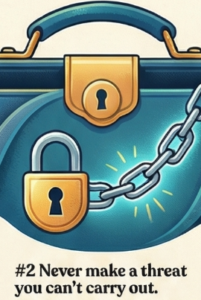
This piece of advice was given to me by the same college advisor (see #1), and like a strong young Padwan, I did what I was told. But unlike #1, this piece of advice is a bit more reliable across multiple situations, even parenthood!
It’s not in my nature to be strict or punitive, but once I realized that the trouble-makers were really just attention-seekers stealing time from 95% of my class, I realized the rules are there for a reason and that enforcing them early and consistently set a standard for the class and allowed a space for learning. Granted, not every broken rule needs a punitive response- with experience you’ll learn which to let go, which to laugh at and which to enforce. My advice is to read the room. Sometimes laughing at yourself or the behavior to diffuse a situation can go far in building relationships. And sometimes, the majority of the class is as annoyed as you are and they are depending on the adult in the room to do something.
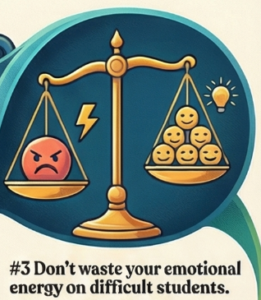
#3 Don’t waste your emotional energy on difficult students.
This one didn’t come easy for me, nor was it intuitive. I had to look back on a particularly difficult year of teaching to realize that I felt so spent, so drained and
so defeated because of only one student in a class of 30. This child was particularly brilliant in our subject matter- European history. Yet, his IEP required writing support, so he was placed in my remedial history class.
Since he knew the material and writing was difficult, he refused to take notes. While the class engaged in writing tasks, he would antagonize his mates, mock those who struggled, constantly and blatantly interrupt me or (thankfully), put his head down and sleep. Thoughts of how I handled a situation, the things he said, how our admin team and support systems were letting us down and what the next day would be like constantly plagued my mind. He was consuming my emotional energy, while the 29 other students never crossed my mind.
Sometime around May when at utter exhaustion, I looked out and saw a room full of hard working, curious, interesting students that were also exhausted. It dawned on me that these students have been with me this whole time. I had to make a conscious effort at first to shift my attention to these students and ignore my attention-seeker. It wasn’t easy, but the effort to engage in and reward positive behaviors ultimately changed the tone of the class. Better late than never, I guess.
Need more info? Read our blog, “Tips for Dealing with Disruptive Students.”
Tricks of the Trade for Teachers on Instruction and Learning
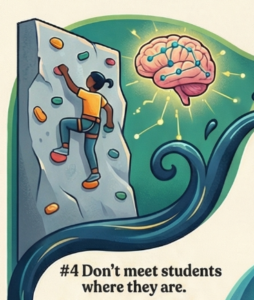
#4 Don’t meet students where they are.
 I don’t know if you know this, but a lot of kids actually don’t like school. Shocking, I know! Ask them and they’ll tell you, “School is hard. School is boring.” With social media apps and YouTube at their fingertips, why would they bother? How can teachers compete?
I’ve started to begin my lessons by explaining how their brains work. Regardless of what you are teaching, let the students know you want this to be hard. You want them to struggle. Why? Because in that uncomfortable space is where we learn. That simple understanding sets the stage for the students to reframe their own thoughts around school and learning.
I give a brief explanation of neuroplasticity and how our brains adapt to what we feed it. If it’s reading, drawing, learning a new skill, working through a problem, we are stressing our brain. Which is the only way we learn. Any app or strategy that takes the struggle out of learning is not effective. In other words, just like stressing muscles in the gym to grow, we must stress the brain. If what you are learning is hard, it’s working. The more we placate or “meet the students where they are,” the less they struggle, the less synaptic connections they make in the brain.
When we don’t push our intellectual limits or spend time on social media to avoid boredom, the brain starts to prune these synaptic connections. The brain will do some inventory and if it’s not using certain connections, it will begin to reduce the number of neural connections. In short, if you don’t use it, you’ll lose it.
Once a student learns this and we reframe the narrative around learning, students show a stronger willingness to struggle. It’s an opportunity to grow- this is why we should never meet students where they are, but just above. Embrace the struggle, this is how we learn.
#5 Don’t let AI write your lesson plans.
It is really tempting to have AI write this blog for me. In fact, I already asked it to do just that, but it spit out a generic, voiceless, common sense bullet list that I wouldn’t put my name on. When it comes to lesson preparation using AI, I have a few thoughts. These are the kinds of tricks of the trade for teachers that develop over time, not from shortcuts.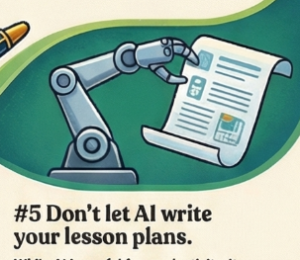
You were hired to teach a curriculum- how you teach is what makes your classroom experience unique. Lesson planning is the creative outlet that called us to this profession. Generative AI cannot possibly improve upon the creativity of an excellent teacher. Don’t get me wrong, AI is great for productivity and helping you execute the ideas from your own mind. For example it was kind of fun to ask Gemini to make a picture of a teacher grading papers in a bar for this blog. Just remember, chat bots are regurgitating materials that are on the internet- there’s not much innovation in that. As for lesson planning, AI will propose standard, generic lessons that work. In other words, for the teacher that lacks creativity or vision, AI may be your answer. But for the excellent teachers out there, spawning and testing their creative ideas, your class needs you!
#6 Bring back the oral presentation.
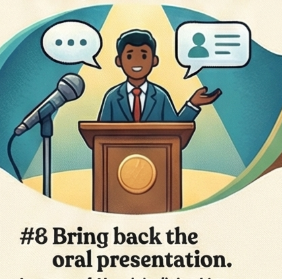 I’m not a fan of oral presentations. The stress it causes the students, the pushback from parents, the IEPs that prohibit them, and the amount of class time they consume are just a few of the reasons I have all but removed oral presentations from my lessons. A few changes in the profession have me rethinking oral presentations. First and foremost, Edtech. The one-to-one initiative that put laptops in the hands of every student with the promise of equity and accessibility has failed my students. After multiple failing report cards, schools are taking a second look at the changes and increases that technology promised. As a veteran teacher, I can honestly say that the students today simply can’t read, write, and communicate as well as they could before the one-to-one tech revolution in schools. I’m not griping about a generational disparity, I’m talking about the significant downfall of our youth’s basic abilities in the past 10 years.
With the advent of AI, teachers’ hands are tied when it comes to academic integrity. The only way to know for certain if student work is authentic or if comprehension occurred is to ask them. Preparing students for today’s world means giving them the skills that LLMs don’t have such as communicating, thinking on their feet, demonstrating depth of knowledge, all of which can be done through the dreaded oral presentation.
#7 Grade papers at the bar.
The way I feel about grading is akin to the way students feel about school. It’s hard and it’s boring. So, in taking my own advice, let’s reframe this experience. First, grading can be a window into our students’ abilities. Isn’t it exciting for us to see growth over time? It’s also an opportunity to assess our own lesson designs. How am I doing? Is the reframing working? It still sounds hollow to me too.
Try this: Take yourself and your papers out to dinner. Find a large booth or table for 1. Spread out, order a good meal and pair it with a nice bold red (pen). Who says you can’t treat yourself while you work? After a few pairings, I’ve all but conditioned myself (almost) looking forward to my teacher’s night out.
Tricks of the Trade for Teachers On Building Relationships
#8 Say Yes to Chatting with Colleagues
In 2016 I moved to a new high school. I taught a new course and felt once again, like a new teacher. Except this time, I was in my 40s. Although I was once again taking mounds of work home with me each night, I made a commitment to myself to always engage with my peers. I left my door open, praying not to be interrupted but never turning down a conversation when I was. I wanted connections with my colleagues. I made an effort to ask their advice, lend an ear, volunteer on their committees and be a presence in my school. Surrounding myself and intentionally engaging with brilliant teachers created an environment I wanted to be in every day. The students will come and go, but the relationships you build with your colleagues are permanent and transformational.
#9 Stay current
 Younger teachers have the advantage here. From fashion to music to tiktok memes, I feel a little out of touch with my students lately. By the time I finish this paragraph, the upcoming context will be dated, but here we go…
For some reason it felt like every time I opened my mouth this year, I said some variation of 6-7. “I think you can find this in your packets on pages 6-7.” Or, “Most of you finished this quiz quickly! It only took 6-7 minutes so congra…” I was caught off guard as kids just started laughing… I had no idea why. Luckily, my college-aged daughter clued me in. “Mom, 6-7 is a thing now. It doesn’t mean anything. Just don’t say it unless you want everyone to laugh at you.” So of course, I started looking for places to say it. Eventually, and not surprisingly, the hilarity wore off.
It’s impossible to be on top of the changing trends of the youth, but we should be somewhat aware of the latest movements among our target population. Instead of trying to speak their language we can focus on understanding the world they live in. Instead of pretending to understand, which kids will see through, show genuine curiosity and vulnerability. Connection comes from respect and engagement, not imitation.
#10 Learn Mahjong.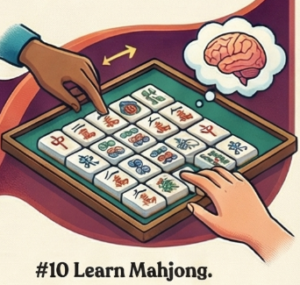
This year, I spent $75 and two Tuesday nights in a Mahjong class with some friends. I felt my brain burn like it was on fire and by the end of my first lesson it turned to mush. I loved every second. Mahjong might not be your thing, but learning a new skill- like coding, pickleball, guitar, anything puts us back in the passenger seat where we can remember what it feels like to be a student. When you find your frustration boiling over because you’ve taught a lesson umpteen times, perhaps it’s time to reframe your perspective. Learn something new. We are the stewards of learning. Be the example and reap the benefits.
These are just a few of the tricks of the trade for teachers that I’ve learned over the years, and I’m still learning more every day.